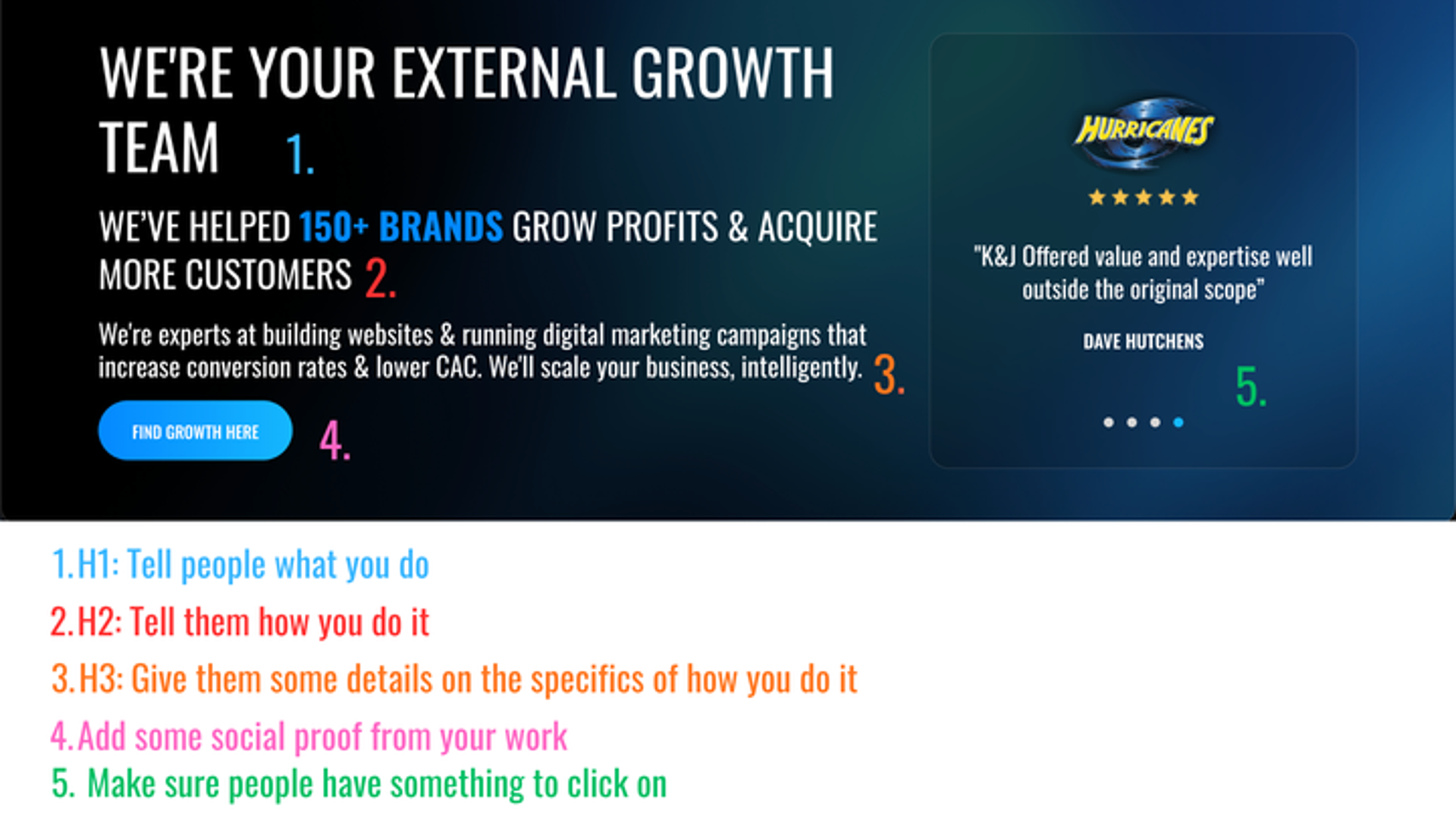
If you want your website or blog to rank on Google and convert visitors into customers, your headings matter more than almost anything else.
A strong H1 tells people what you do, H2s explain how you do it, H3s add depth and clarity – and social proof builds trust instantly. When combined with a clear CTA, this structure can dramatically increase conversions, reduce bounce rates, and improve SEO performance.
Most founders get this wrong. They either write vague headings (“Welcome to our site”) or overly clever ones that confuse users and search engines. The result? Low rankings, poor engagement, and wasted traffic.
This guide gives you a clear, tactical framework to write H1s, H2s, H3s, and social proof sections that:
- Rank for 10–25+ search queries per page
- Communicate value instantly (within the first 150 words)
- Convert visitors into leads or customers
 Don’t have time to read all this right now? Scroll down to our FAQ at the bottom or watch our Youtube video where I walk you through it here.
 Why Headings Matter for SEO and Conversion
Headings are not just formatting – they are information architecture for both humans and search engines.
They help:
- Google understand your page (keyword relevance, structure)
- Users scan quickly (reducing cognitive load)
- Increase time on page (improving rankings)
- Drive conversions (clear messaging = action)
Think of your page like a sales conversation:
- H1 = What you do
- H2 = How you do it
- H3 = Proof, depth, and specifics
- Social Proof = Why people should trust you
- CTA = What to do next
 How to Write a High-Converting H1
Your H1 is the single most important line on your page.
What a Good H1 Does
- Clearly states what you do
- Includes a primary keyword
- Speaks to a specific audience or outcome
- Avoids fluff or cleverness
Formula for a Strong H1:
[What you do] + [Outcome] + [ Audience or Differentiator]
| Weak H1 | Strong H1 |
| Welcome to Our Website | We Build High-Converting Websites That Reduce CAC |
| Marketing Services | Digital Marketing That Drives Profitable Customer Growth |
| Growth Agency | We Help Brands Scale Revenue with Paid Ads & Conversion Optimisation |
Why This Works
- It answers the user’s question immediately
- It aligns with search intent
- It positions value, not features
Your H1 should pass this test:
 How to Write Effective H2s
If the H1 is the promise, your H2s are the mechanism.
They break down:
- How your product/service works
- Your process or methodology
- Key benefits or pillars
What Makes a Strong H2
- Outcome-driven
- Clear and specific
- Structured around user intent
Example Structure (Based on Your Image)
H1: We’re Your External Growth Team
H2 Options:
- We Help Brands Grow Profits & Acquire More Customers
- We Build Websites That Convert & Lower CAC
- We Run Data-Driven Campaigns That Scale Revenue
Best Practice Framework
Use 3–5 H2s that answer:
- What do you do?
- How do you do it?
- Why does it work?
- What makes you different?
Mistakes to Avoid
- Being vague (“Our Services”)
- Overloading with jargon
- Writing for yourself, not the customer
 How to Write H3s – Lets Look at the Specifics
H3s are where you earn credibility.
They:
- Expand on your H2 claims
- Provide detail, examples, or process
- Improve SEO by capturing long-tail queries
What Good H3s Look Like
Under an H2 like:
“We Build Websites That Increase Conversions”
Your H3s could be:
- Conversion-focused UX design principles
- Landing page frameworks that reduce drop-off
- CRO testing and optimisation cycles
Why H3s Matter
- Capture long-tail SEO queries
- Improve readability (scan-friendly content)
- Build authority and trust
Pro Tip: Every H3 should answer: “What specifically do you mean by that?”
 How to Use Customer Social Proof
Social proof is often the highest-leverage conversion element on your page.
Without it, your claims are just claims.
Types of Social Proof That Work Best:
| Type | Example |
| Testimonials | “K&J helped us scale beyond our original scope” |
| Case Studies | Increased revenue by 42% in 90 days |
| Logos | Recognisable brands you’ve worked with |
| Metrics | “150+ brands helped” |
How to Structure Social Proof:
Place it:
- Immediately after your H1/H2 section
- Near key conversion points
- Before your CTA
High-Converting Example:
“We’ve helped 150+ brands grow profits and acquire more customers”
Then reinforce with:
- Specific outcomes
- Named clients (if possible)
- Quantified results
Why This Works
- Reduces perceived risk
- Builds instant credibility
- Moves users closer to action
 Putting It All Together (Example Structure)
Here’s a simple structure you can follow:
H1
We’re Your External Growth Team
H2:
We Help Brands Grow Profits & Acquire More Customers
H3:
- Data-driven paid media strategies
- Conversion-optimised landing pages
- Continuous testing and iteration
Social Proof:
“Helped 150+ brands scale profitably”
CTA
Find Growth Here
 CTA Section: Turn Attention Into Action
Your CTA is where most websites fail.
What a Strong CTA Does:
- Tells users exactly what to do
- Reduces friction
- Reinforces value
High-Converting CTA Examples
- Book a Growth Strategy Call
- Get a Free Audit
- Find Growth Here
- See How We Scale Brands
CTA Best Practices
- Use action-oriented language
- Keep it short (2–5 words ideally)
- Place it above the fold and throughout the page
- Pair it with social proof
Pro Tip: Your CTA should answer: “What is the easiest next step for this user?”
 Final Takeaway
If you get this right, your website stops being a brochure – and starts becoming a growth engine.
Most founders overcomplicate this. The reality is simple:
- Clarity beats cleverness
- Structure drives conversions
- Proof builds trust
- CTAs capture value
If your headings don’t clearly communicate what you do, how you do it, and why it works – you’re leaving money on the table.
 Ready to Fix Your Website?
If you want your site to:
- Rank for more keywords
- Convert more traffic
- Reduce CAC
Or book a strategy session and we’ll break down exactly where your current structure is costing you conversions.